 Stader
 ETHx: Pooled ETH, Staking Rewards and DeFi Use
Stader ETHx represents pooled staked ETH in a transferable token whose exchange rate incorporates staking rewards. ETH deposits enter Stader’s staking contracts, while ETHx gives the holder an asset compatible DeFi applications can accept. The ETH represented by an ETHx holding can differ from an ETHx-to-ETH swap quote or the amount payable on redemption. Selling ETHx transfers token ownership; a protocol redemption request creates a pending ETH claim.
Updated on
On this page
Deposited ETH and the Liquid Token
An ETH deposit funds the staking pool, while the ETHx it produces gives the holder a transferable share of that pool.
ETH in the Staking Pool
Stader’s contracts pool deposited ETH, and node operators run Ethereum validators. Those validators propose and attest to blocks, producing staking rewards through Ethereum’s consensus process. Validator penalties and slashing can reduce the staked ETH backing ETHx. The ETHx holder participates through a transferable claim on the pool, while operators handle the infrastructure and validator work.
ETHx in the Holder’s Position
ETHx issuance follows the pool exchange rate, so an ETH deposit need not produce an equal token count. ETH measures the underlying asset; ETHx measures units of participation. A transfer changes who holds those units without requiring a validator exit. Obtaining ETH through the protocol follows a separate redemption process, with its own request and withdrawal states.
Reward Accrual and Fee Recipients
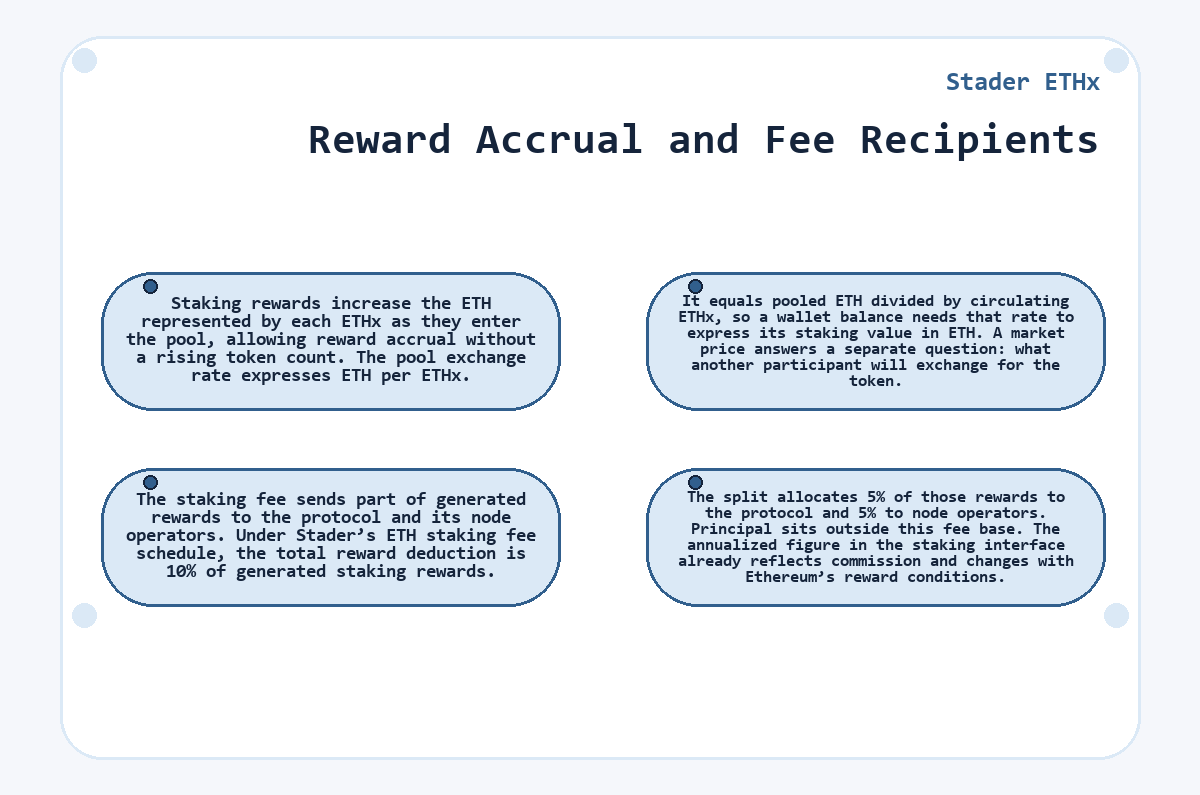
Staking rewards increase the ETH represented by each ETHx as they enter the pool, allowing reward accrual without a rising token count. The pool exchange rate expresses ETH per ETHx. It equals pooled ETH divided by circulating ETHx, so a wallet balance needs that rate to express its staking value in ETH. A market price answers a separate question: what another participant will exchange for the token.
The staking fee sends part of generated rewards to the protocol and its node operators. Under Stader’s ETH staking fee schedule, the total reward deduction is 10% of generated staking rewards. The split allocates 5% of those rewards to the protocol and 5% to node operators. Principal sits outside this fee base. The annualized figure in the staking interface already reflects commission and changes with Ethereum’s reward conditions.
How Does ETHx Carry Staking Exposure Into DeFi?
DeFi use gives ETHx another function as a tradable asset or supported protocol deposit, with the token continuing to represent the staking pool.
Token Trading
Trading transfers ownership of ETHx at the market’s execution terms. The available liquidity and trade size can affect the ETH received in an ETHx-to-ETH swap. The pool exchange rate measures represented ETH, while the trading quote estimates market proceeds. A quote does not establish a completed swap or an ETH amount already held in the wallet.
Wallet Balances and Application Positions
Wallet-held ETHx gives direct exposure to the token’s staking value. Depositing ETHx into a supported application creates a position subject to the receiving protocol’s contracts. Its accounting determines how it represents that exposure, and its withdrawal terms determine access to the assets. The ETHx pool rate alone cannot describe the amount an application position will return.
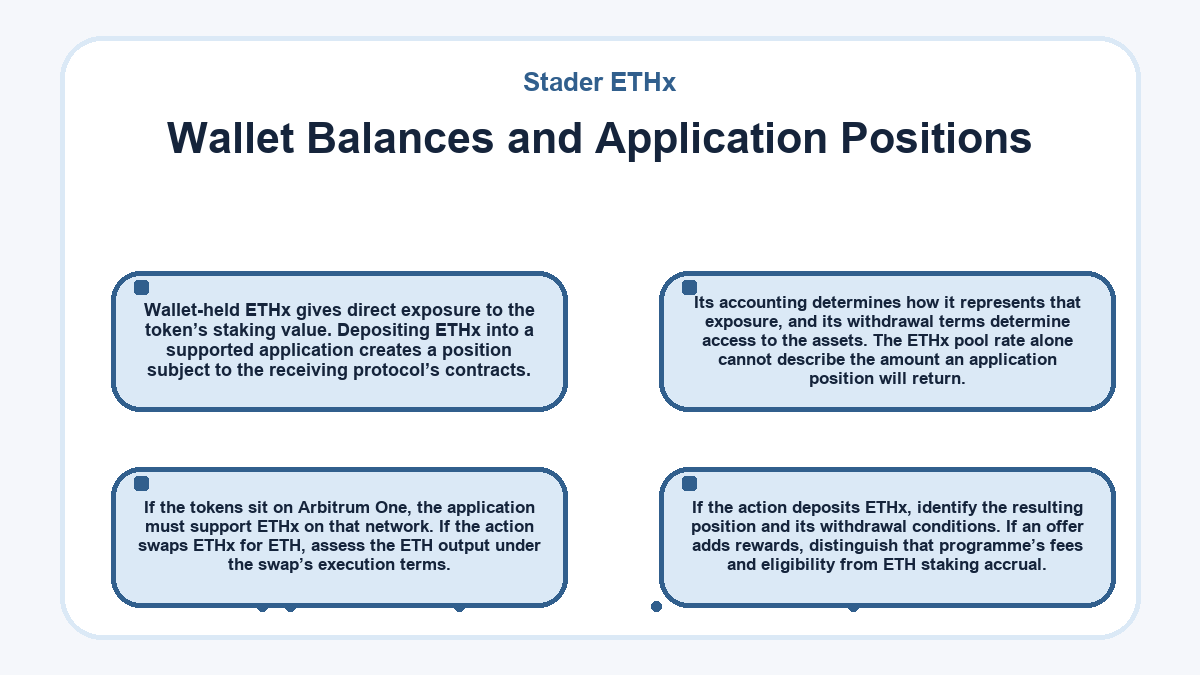
- If the tokens sit on Arbitrum One, the application must support ETHx on that network.
- If the action swaps ETHx for ETH, assess the ETH output under the swap’s execution terms.
- If the action deposits ETHx, identify the resulting position and its withdrawal conditions.
- If an offer adds rewards, distinguish that programme’s fees and eligibility from ETH staking accrual.
Ethereum and Arbitrum One Exit Routes
Ethereum and Arbitrum One support ETH deposits for ETHx, while the network holding the token determines the route back to ETH. Stader’s Ethereum route converts ETHx through a protocol unstaking request followed by an ETH claim.
On Arbitrum One, ETHx holders can swap the token for ETH through a decentralized exchange (DEX) or bridge ETHx to Ethereum for redemption, where the Ethereum request and withdrawal conditions apply after the transfer. Bridging moves ETHx between networks. It does not itself complete an ETH withdrawal.
Redemption States and Claimable ETH
An Ethereum unstaking request moves the submitted ETHx from a reward-accruing holding into a pending ETH withdrawal with separate settlement conditions. Reward accumulation stops for the ETHx included in the request when unstaking begins. The remainder of a holder’s ETHx balance stays a separate position.
Unstaking approval grants the protocol permission to handle ETHx. It leaves the holding unchanged. The actual unstaking request starts redemption; approval alone does not create a pending ETH withdrawal.
ETHx redemption on Ethereum uses the lower ETH-per-ETHx exchange rate at request time or finalization. A higher pool rate after submission therefore does not automatically increase the pending claim. The rate displayed for freely circulating ETHx and the rate settling a withdrawal can consequently describe different amounts.
Ethereum unstaking typically takes 7-10 days, subject to the network’s entry and exit queues. The estimate can change with queue conditions. In Stader’s staking application, claim the available ETH through the Withdraw tab after the request has been processed. Claiming makes the released ETH available to the holder.
Contract Controls Behind DeFi Availability
ETHx depends on Stader’s staking contracts and Ethereum even when another application accepts the token, and a deposit into that application introduces another set of contracts governing access to and withdrawal from the resulting DeFi position. Stader addresses protocol vulnerabilities through public code, audits and a bug bounty programme. Those measures leave residual smart contract risk. The receiving application’s contracts bring their own failure and withdrawal conditions.
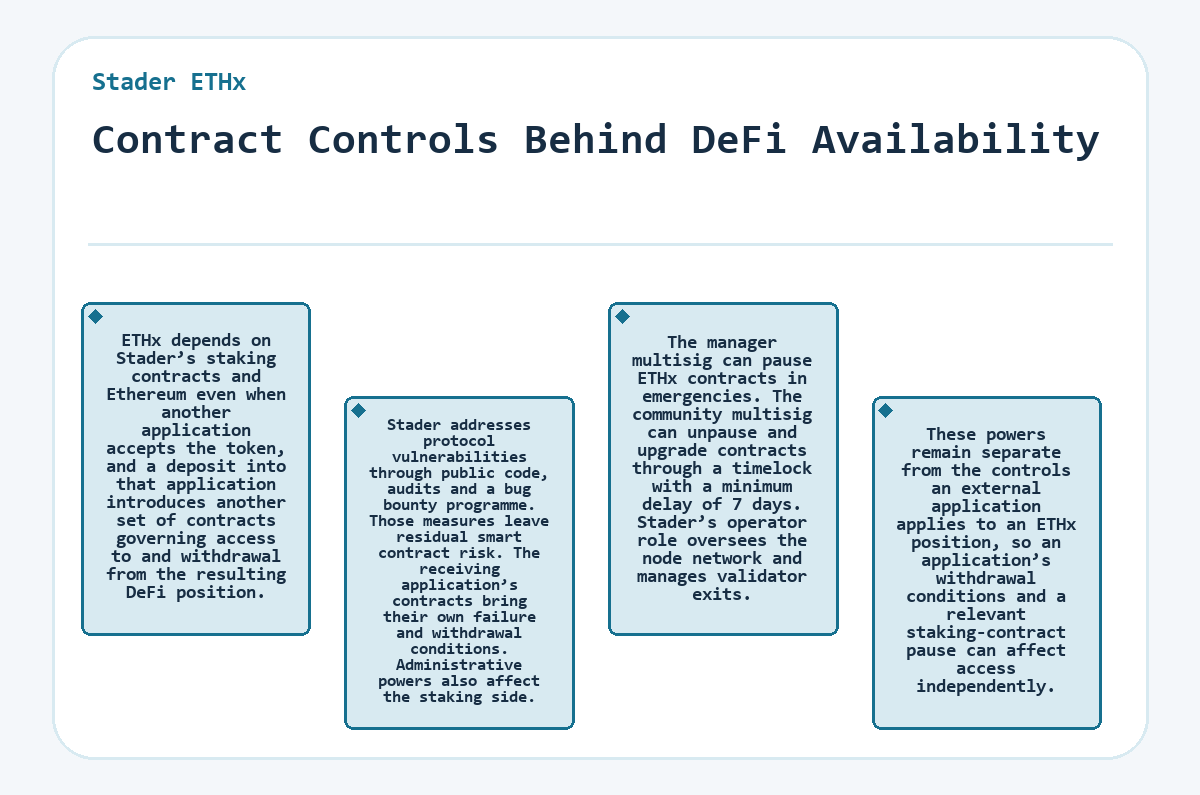
Administrative powers also affect the staking side. The manager multisig can pause ETHx contracts in emergencies. The community multisig can unpause and upgrade contracts through a timelock with a minimum delay of 7 days. Stader’s operator role oversees the node network and manages validator exits. These powers remain separate from the controls an external application applies to an ETHx position, so an application’s withdrawal conditions and a relevant staking-contract pause can affect access independently.
Common questions about Stader ETHx
Which Asset Pays Gas When Staking ETH for ETHx?
ETH pays the network transaction fees for ETH staking routes on Ethereum and Arbitrum One. Holding ETHx does not replace that gas balance. Network gas charges are separate from the staking rewards commission. Stader adds no transaction fee for staking through its application.
Is ETHx the Token Used for Stader Governance?
SD supports Stader governance participation, while ETHx represents pooled staked ETH. The SD Utility Pool also supports ETHx node operators through a separate SD delegation mechanism. An ETHx holding and an SD delegation balance therefore describe different assets and reward arrangements.
Can a Connected Wallet Introduce Risks Beyond the ETHx Contract?
The wallet used to access ETHx introduces a security dependency separate from Stader’s staking contracts. Connecting a wallet and authorizing a token operation are different actions. Wallet security and the permissions granted to an application affect access to the holding; protocol-level contract audits do not resolve those separate dependencies.
What Happens If the ETHx Pool Exchange Rate Is Manipulated?
Exchange-rate manipulation can distort both ETHx issuance and ETH redemption amounts. An attacker could obtain too much ETHx for an ETH deposit or redeem ETHx for disproportionate ETH, affecting the pool supporting other holders. This risk concerns the rate used by the staking contracts, separately from ordinary changes in a DEX trading price.
Has ETHx Been Discontinued Alongside MaticX and BNBx?
ETHx remains a supported Ethereum liquid staking product; MaticX and BNBx were discontinued. MaticX served Polygon, and BNBx served BNB Chain. Those discontinuations concern their respective staking products and do not set the withdrawal conditions for an ETHx holding on Ethereum or Arbitrum One.