 Stader
 node operators: ETHx Bonds, Infrastructure and Validator Duties
Stader node operators run Ethereum validators backing ETHx, with permissionless entry combining an ETH bond, SD collateral and maintained validator infrastructure. Each permissionless validator needs a 4 ETH operator bond and at least 0.4 ETH worth of SD. Operators can supply their own SD or obtain it through the SD Utility Pool, which adds utilization fees and repayment obligations. The permissioned route has a separate admission process.
Updated on
Bottom line: The 4 ETH permissionless bond applies per validator, so adding validators increases capital requirements even when they share one node.
Validator Duties, Pool Funding and Admission
ETHx node operation connects Ethereum consensus duties with capital supplied through the staking pool. Validators attest and propose blocks, while operators maintain their machines and signing configuration. ETHx holders participate through a liquid token representing pooled stake. Permissionless operators contribute bonded capital alongside the pool’s funding. Permissioned admission follows a separate setup involving operator-address whitelisting and Web3Signer. Maintaining clients and collateral creates an operational commitment beyond holding ETHx.
What Capital Does a Permissionless ETHx Validator Require?
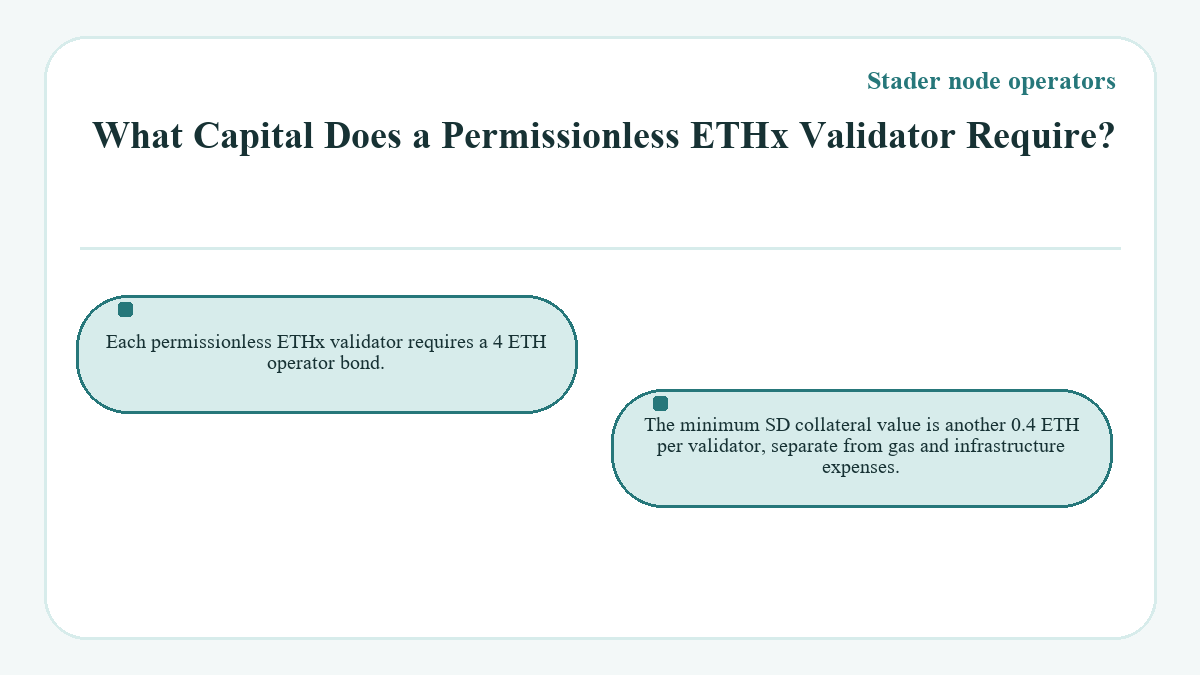
Each permissionless ETHx validator requires a 4 ETH operator bond. The minimum SD collateral value is another 0.4 ETH per validator, separate from gas and infrastructure expenses.
Self-Bonded SD
Self-bonding commits the operator’s own SD as collateral. The requirement measures SD’s value in ETH, so it does not specify a fixed token count. Changes in the relative prices of ETH and SD affect that collateral ratio. Adding validators increases the required collateral, even when those validators share a host. Without validator exits, SD collateral withdrawals are limited to the amount above 8 ETH worth per validator. Withdrawing the entire SD bond requires exiting the validators.
SD From the Utility Pool
Utility Pool funding supplies the SD bond without requiring operator-owned SD. The permitted amount depends on validator count, the existing utilization position and free SD in the pool. Borrowing introduces an ongoing obligation with accrued utilization fees. Operators must budget for that obligation alongside their ETH bond. Pool-funded SD also requires attention to the node’s health factor, which governs liquidation exposure.
Hardware Capacity and Client Configuration
Permissionless operation needs a host for Ethereum clients, a Stader CLI installation and connectivity suitable for continuous validator duties.
Host and Network Capacity
The permissionless hardware recommendations include a four-core AMD64 or ARM64 processor, 16 GB of RAM and a 2 TB SSD. Network recommendations specify at least 25 Mbps, a monthly data allowance of 2 TB or more and stable electricity. These figures describe recommended capacity, not a promise of fixed resource consumption. Physical hardware and virtual infrastructure both appear in the operator setup options. Hosting charges, storage capacity and connectivity belong in the operating budget alongside the bonded assets.
Execution and Consensus Clients
Stader’s setup configures an execution client and a consensus client before synchronization. Docker supports the node stack, while the CLI manages configuration and node operations. Software releases and patches require ongoing maintenance. Firewall rules and access controls protect the host, with required network ports depending on the selected clients. A working installation must also remain connected and synchronized to perform validator duties.
Node Setup and Validator Funding
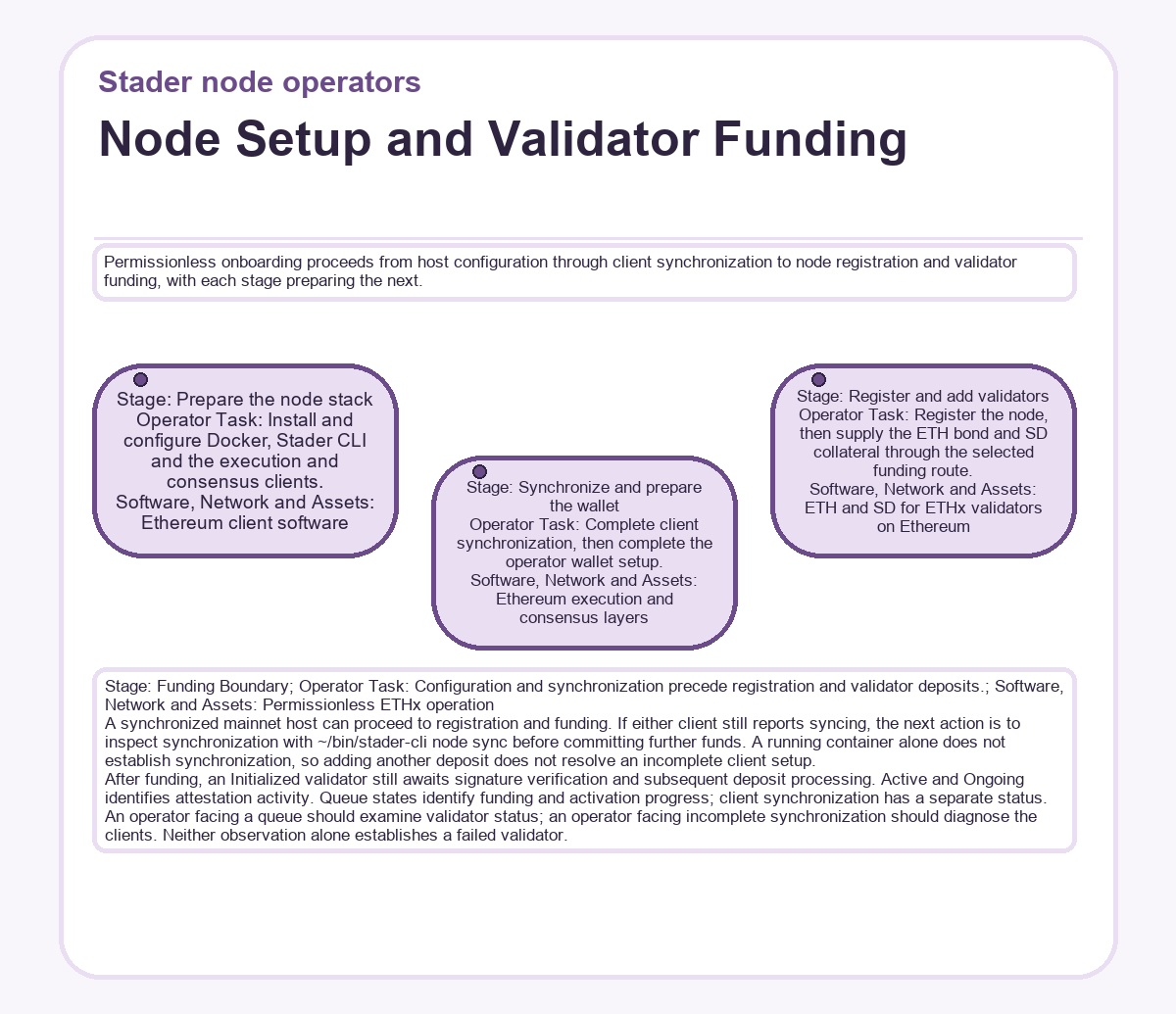
Permissionless onboarding proceeds from host configuration through client synchronization to node registration and validator funding, with each stage preparing the next.
| Stage | Operator Task | Software, Network and Assets |
|---|---|---|
| Prepare the node stack | Install and configure Docker, Stader CLI and the execution and consensus clients. | Ethereum client software |
| Synchronize and prepare the wallet | Complete client synchronization, then complete the operator wallet setup. | Ethereum execution and consensus layers |
| Register and add validators | Register the node, then supply the ETH bond and SD collateral through the selected funding route. | ETH and SD for ETHx validators on Ethereum |
| Funding Boundary | Configuration and synchronization precede registration and validator deposits. | Permissionless ETHx operation |
A synchronized mainnet host can proceed to registration and funding. If either client still reports syncing, the next action is to inspect synchronization with
~/bin/stader-cli node sync
before committing further funds. A running container alone does not establish synchronization, so adding another deposit does not resolve an incomplete client setup.
After funding, an Initialized validator still awaits signature verification and subsequent deposit processing. Active and Ongoing identifies attestation activity. Queue states identify funding and activation progress; client synchronization has a separate status. An operator facing a queue should examine validator status; an operator facing incomplete synchronization should diagnose the clients. Neither observation alone establishes a failed validator.
Operator Earnings and Execution-Layer Reward Routing
Permissionless operator income combines rewards on bonded ETH with commission for operating validators funded partly by ETHx depositors. The staker-facing annual reward display already reflects staking commission; it does not calculate an operator’s net profit. Infrastructure bills, transaction gas and any SD utilization fees affect that calculation. Consensus-layer rewards arise from validation duties. Execution-layer rewards include transaction priority fees and maximal extractable value, or MEV, associated with proposed blocks. Their variability makes a fixed annual income assumption unsuitable.
Permissionless operators can pool execution-layer rewards through the Socializing Pool or use an individual Stader-created fee-recipient contract. Both arrangements divide rewards between operators and ETHx stakers. The shared pool distributes participation-weighted rewards, taking account of validator attestations, missed attestations and time opted in. Pooling changes exposure to uneven block-proposal rewards; it does not remove performance requirements. The choice also affects reward routing, so an arbitrary personal wallet is not interchangeable with the designated fee-recipient contract.
Maintenance and Safe Host Migration
Node maintenance continues throughout the validator’s lifespan, including software updates, network health monitoring and participation in Ethereum consensus.
Stader’s monitoring setup includes a Grafana dashboard for node metrics. Monitoring helps identify connectivity and synchronization problems requiring attention. Moving validators to another host adds a separate signing risk: the old system must be completely shut down and its validators must stop attesting and proposing before wallet recovery on the replacement. Running the same validators on both systems can cause double signing and slashing. The migration process synchronizes the replacement before wallet recovery, then checks node and validator status.
When Can an Operator Recover the ETH Bond?
An operator can claim the remaining ETH bond after validator exit and protocol settlement, with outstanding Utility Pool utilization fees affecting release.
The permissionless exit flow requires an active validator and 256 epochs since activation. Ethereum exit and withdrawal processing precede Stader’s settlement and claim stages. An exit message therefore does not establish an immediately spendable balance. Node termination comes after successful exits and claims.
An operator’s SD utilization position equals utilized SD plus accrued utilization fees. The node’s health factor compares a portion of ETH collateral with accrued utilization fees. Borrowed principal remains part of repayment even though only fees enter that denominator.
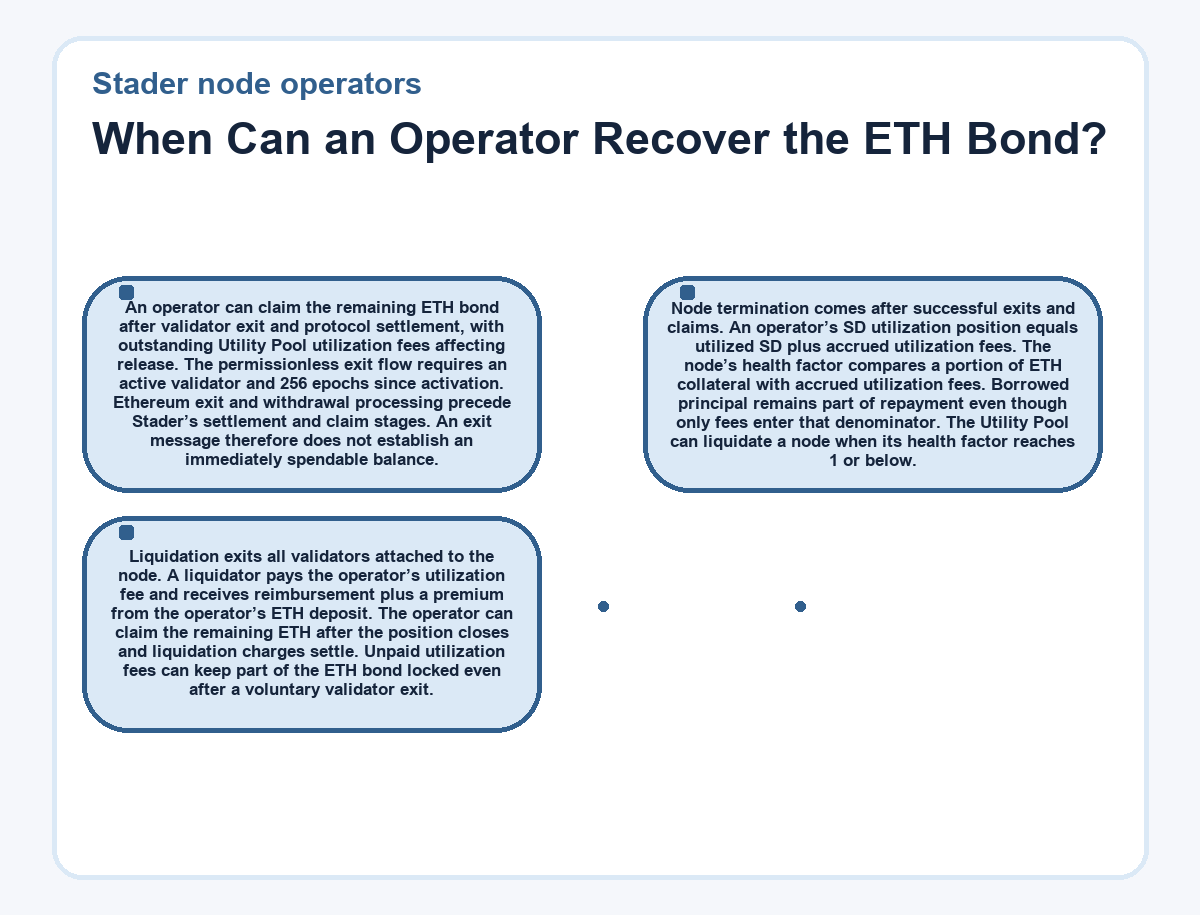
The Utility Pool can liquidate a node when its health factor reaches 1 or below. Liquidation exits all validators attached to the node. A liquidator pays the operator’s utilization fee and receives reimbursement plus a premium from the operator’s ETH deposit. The operator can claim the remaining ETH after the position closes and liquidation charges settle. Unpaid utilization fees can keep part of the ETH bond locked even after a voluntary validator exit.
What readers ask about Stader node operators
Which Operating Systems Does the Permissionless Stader Setup Support?
The permissionless prerequisites list Ubuntu Linux and macOS on Intel or M1 hardware. The processor recommendations cover AMD64 and ARM64 architectures. A Docker installer being available for another operating system does not establish compatibility with the complete Stader node stack.
What Happens If self-bonded SD Falls Below the Reward Threshold?
Self-bonded collateral below the 0.4 ETH-per-validator reward threshold at the daily snapshot earns no SD rewards for that day. The snapshot uses a randomly selected block. Relative ETH and SD price movements can change eligibility even when the deposited SD token count remains unchanged.
Can a Permissionless Operator Change the Reward Address?
A permissionless operator can change the reward address through authorization by the existing address and confirmation by the new address. When operator and reward addresses match, the proposal can use the CLI or smart contract. Different addresses require the existing reward address to propose through the smart contract; the new address confirms through the contract in either case.
How Long Must an Operator Wait Between Socializing Pool Changes?
Permissionless Socializing Pool participation has a 56-day cool-off period between opting in and opting out, in either direction. After that period, an opt-in or opt-out command takes effect three epochs after execution, approximately 20 minutes. Participation applies to the whole node, including all its validators.
Is the Protocol Operator Role the Same as Running an ETHx Node?
The Stader team’s protocol Operator role differs from operating an individual ETHx validator node. That protocol role oversees node-network health, implements node configuration changes and manages validator exits. Community and Manager multisigs hold other contract-control powers. Permissionless validator operation does not confer those protocol administration permissions.
Does a Duplicate Grafana Dashboard UID Indicate a Validator Failure?
A duplicate dashboard UID indicates a dashboard import conflict and does not establish a validator failure. Grafana’s Change uid control allows a different identifier for the imported dashboard. Client synchronization and validator status remain separate from that monitoring configuration issue.
Which Firewall Ports Does the Stader Client Configuration Require?
The listed Stader execution-client configuration uses port 30303 over TCP and UDP. The listed Lighthouse configuration uses 9001 over both protocols; Prysm uses TCP 13000 and UDP 12000. These are client-specific configurations, so the selected consensus client determines which corresponding ports apply.
Are Simultaneous Stader Testnet and Mainnet Nodes Supported on One Machine?
Reusing a testnet host for mainnet requires terminating the testnet node and removing its testnet Stader directory before mainnet setup. Simultaneous deployments can conflict through directories and ports. This host-reuse requirement concerns separate testnet and mainnet installations.